


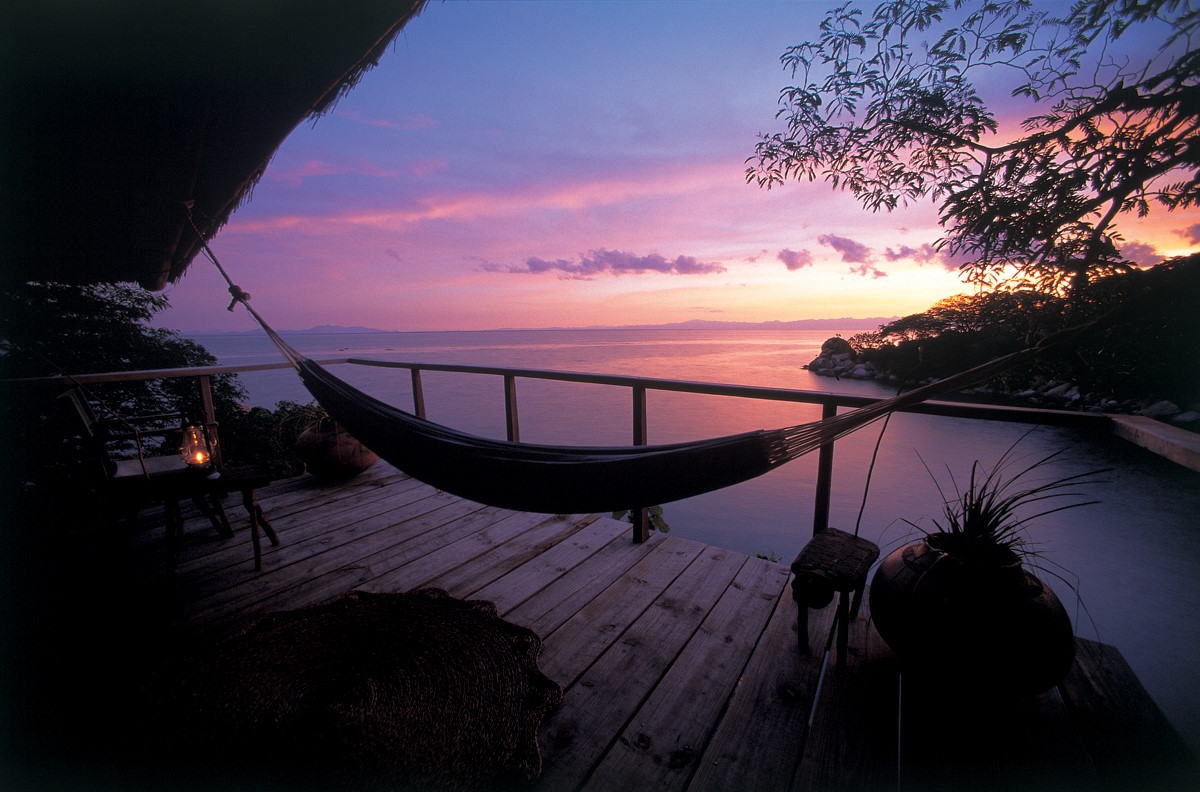

in Lake Malawi National Park

Lake Malawi
Lake Malawi National Park
Welcome to Mumbo Island!

Mumbo Island is a pristine and deserted tropical island and the undisputed jewel of the Lake Malawi National Park. Mumbo Island has never been inhabited and is still in its natural state with a thick covering of miombo woodland and ancient fig and baobab trees.
The island is 10km offshore of Cape Maclear. Visitors must first get to Kayak Africa’s reception on the mainland beach at Cape Maclear, from whence twice-daily boat transfers ferry guests to the island and back.
The island is about one square kilometre in extent and is completely undeveloped apart from the tiny camp at the main beach. A network of walking trails allows visitors to explore the forest and access other small beaches and coves.
The waters around the island are clear and calm, perfect for all guests – irrespective of fitness or experience – to enjoy swimming, sea kayaking, snorkelling and SCUBA diving. The waters are regularly tested for bilharzia and have always come up clean!
The whole island is part of the Lake Malawi National Park and falls within Kayak Africa’s exclusive concession area, guaranteeing privacy in paradise.

Kayak Africa and Mumbo Island!

Reception and Central Reservations
Kayak Africa’s Mumbo Island reception is on the mainland beach at Cape Maclear towards the western end of the village. Reception is open during business hours seven days a week and walk-in visitors are welcome to pop in to inquire about the island camp.
Boat transfers to the island depart reception twice daily, and secure parking is available for self-drive guests.
Kayak Africa’s central reservations office in Cape Town has more than thirty years of experience to help you get to Malawi, to the island and anywhere else in this unique and friendly country. Use the details on the Contact page to access personalised and focussed service of the highest calibre.


The Lake Malawi National Park
In 1980 the Lake Malawi National Park became the first fresh-water marine reserve to be proclaimed on earth, and was declared a Natural World Heritage Site in 1984.
Lake Malawi contains the largest number of fish species of any lake in the world, probably well over five hundred with perhaps half occurring in the National Park area. The cichlid fish population specifically is of comparable importance in the study of evolution to the finches of the Galapagos Islands, with adaptive radiation and speciation (the actual process of evolution) taking place continuously even to this day!
Lake Malawi is unique and forms a separate bio-geographical province. It is estimated to be between three and twenty million years old. The lake is 600km long, 80km wide and over 700m deep; and is the southern extremity of the African Rift Valley.
More about Cape Maclear
Cape Maclear is an enclave within the terrestrial portion of the Lake Malawi National Park. It is – at the same time – a traditional African fishing village and Malawi’s premier lakeshore recreational destination. Not to mention the best beach on the shores of Lake Malawi!
A variety of lodges, bars and restaurants overlook the beach and water from between the residences of the local inhabitants. In front of the beach the waters of Lake Malawi stretch away for hundreds of kilometers, dotted in the foreground by the islands of the Lake Malawi National Park. Behind lie vegetable gardens and fields. All around rise the wooded hills that form the rim of the African Rift Valley.
Cape Maclear has a long history of hosting visitors from far away. In the late 1940’s Sunderland Flying Boats landed here as one of the overnight stops on the route between London and South Africa (other stops included the Nile River in Cairo, Kampala on Lake Victoria, the Zambezi River at Victoria Falls and the Vaal Dam near Johannesburg). Well-heeled passengers overnighted in a fancy hotel of which only ruins remain today.
In the 1980’s a local entrepreneur Earnest Stephano Simeji opened Mr. Steven’s Resthouse to cater for the first backpackers to venture through Malawi. This iconic establishment was the only such facility at Cape Maclear for nearly 15 years, and Mr. Steven’s battered but reliable Datsun 1200 pickup the only transport between Cape Maclear and the nearest town of Monkey Bay.
Today approximately 15 establishments dot the shoreline and offer visitors accommodation, food and drink and activities such as snorkelling trips and sunset cruises.
Despite the many changes that have evolved over the years Cape Maclear remains a place of peace and fun. Your alarm clock is the timeless rhythm of gentle waves lapping the shoreline, interspersed by the haunting cry of fish eagles gliding above.
Getting There
Where is it?
Kayak Africa reception is on the mainland beach at Cape Maclear, near the southern end of Lake Malawi. The nearest town is Monkey Bag 25km away.
GPS coordinates for reception are -14.03013, 34.83240.
Click this link for the Google Maps locator for Kayak Africa reception
Getting there from within Malawi:
Self-drive:
Cape Maclear is about 275km from either Blantyre or Lilongwe. Four-wheel drive vehicles are not required, and there is secure parking available at reception.
Road transfers:
Road transfers are available from the main centres in Malawi (Lilongwe and Blantyre) and from nearby lodges such as Makokola Retreat and Mvuu Lodge. Please inquire with our central reservations for more details.